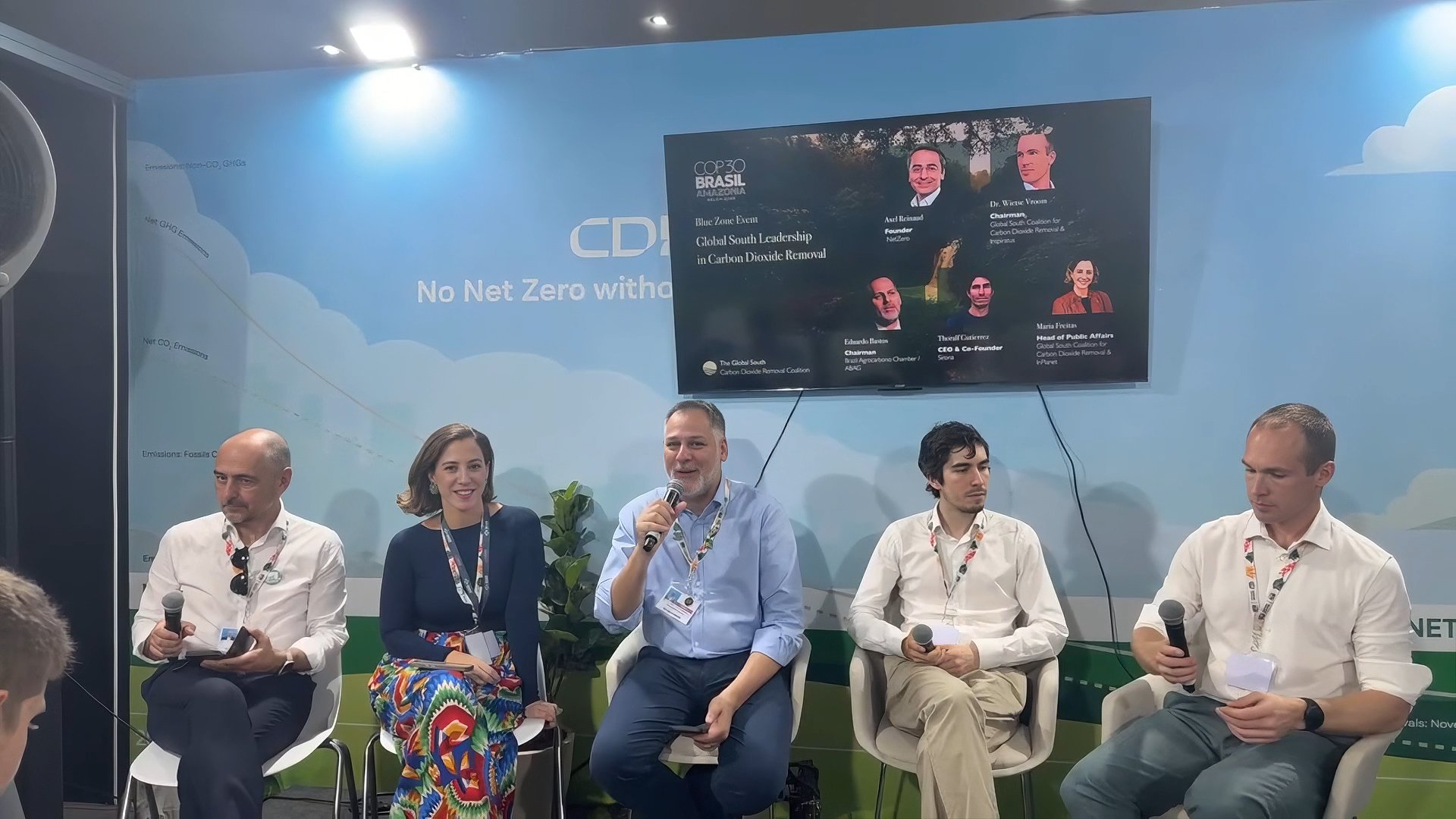
Standing in the Blue Zone at COP30, it became clear to me that one of the most significant shifts wasn’t happening inside the formal negotiation rooms, but in a packed Pavilion, C109. No, not a Star Wars droid. It was the first-ever Carbon Dioxide Removal (CDR) Pavilion at COP, hosted by the CDR30 coalition. This marked a historic moment: never before had a COP dedicated an entire pavilion to carbon removal. In that space, policymakers, scientists, and suppliers confronted an unavoidable truth: the world will not meet its climate goals without CDR. InPlanet was proud to contribute to the coalition as both a steering member and financial backer, and we are deeply grateful to the Negative Emissions Platform for making this milestone possible. As a representative of InPlanet and as a Brazilian, I take the argument further: CDR will not scale without the Global South. In the session I helped host, and in my role on the Global South CDR Steering Committee, we made that case clear.
We see a geopolitical shift already underway
Global south nations are not merely well-suited for carbon removal, they are indispensable. Yet these countries remain held back by financing barriers and outdated regulatory caution, that no longer match the reality of the day.
Europe is opening the door to the global south
The EU’s recent decision to allow up to 5% international credits in its 2040 climate target marks a historic shift, one that many of us in the Global South have been fighting for. For the first time, Brussels is formally acknowledging that carbon credits generated outside the bloc may count toward Europe’s own climate goals. It’s a cautious step, but a meaningful one, signaling a simple truth: climate leadership does not end at Europe’s borders.
As a Global South operator, I see this as a positive and overdue development. It legitimises international climate cooperation, creates a pathway for durable removals, and, above all, offers a blueprint for what Article 6 could look like in practice. By allowing international credits to be recognised within one of the world’s most influential trading blocs, Europe has created the possibility of a real market. It is often said that Europe is the world’s leading exporter of policy, and yet here more than ever. The door is open. The question now is who will walk through it?
As Dr. Wietse Vroom, Chief Technology Officer at Inspiratus Technologies and Chair of the Global South CDR Coalition, put it on our panel:
“Europe is moving, but it is moving in slow, hesitant steps. This 5% flexibility could unlock significant volumes of high-quality credits, but only if policymakers understand the distinction between credible removals and everything else in the voluntary market. We have a long history of carbon credits that did not deliver the climate benefit they claimed. If Europe repeats that mistake, we lose both environmental integrity and political legitimacy. But if Europe uses this opening to recognize durable, scientifically robust removals, especially from the Global South, it can set the global benchmark for quality. The opportunity is enormous, but only if integrity is the starting point.”
Wietse is right to highlight the danger of repeating past mistakes, but from my perspective, this is also a moment to recognize how much has changed. We now have the science, MRV, durability frameworks, and CRCF guardrails to clearly distinguish credible removals from everything else. Integrity is no longer a vague aspiration; it is measurable, and operational. That is why I remain optimistic. The 5% is not a finish line, it’s a starting point. It marks the beginning of a more interconnected, rigorous, and global carbon market.
The global south has the world’s strongest natural advantages
“When we talk about carbon removal, we have to talk about comparative advantage. Europe’s comparative advantage is regulation, sophisticated, complex, often burdensome, but globally influential. The Global South’s comparative advantage is the sun. Sunlight drives photosynthesis for biochar, accelerates mineral weathering, powers low-cost renewable energy for DAC, and supercharges the entire carbon cycle. If you ask where the world can remove CO₂ efficiently, effectively, and affordably, the answer is the tropics. This is not ideology, it’s physics, chemistry, energy economics. The Global South is simply the place where carbon removal works best.”
Said Axel Reinaud, CEO of NetZero and member of the Global South Coalition.
Sitting on that panel, I felt the point land: the Global South doesn’t just contribute to CDR, it underpins it. In Brazil and across the tropics, the natural conditions for large-scale carbon removal already exist. Take Enhanced Rock Weathering (ERW). Brazil’s warm, humid climate accelerates silicate weathering, enabling faster and more reliable CO₂ capture than in many temperate regions.
This is why the next phase of global climate cooperation requires a genuine mindset shift. Today, about 45% of all carbon removals occur in the Global South, while Europe accounts for roughly 11%. If carbon removal is confined primarily to Europe or the US, it will be slow, costly, and limited to meet planetary needs. The physics are unambiguous: scaling carbon removal depends on the Global South.
In the Global South, we are not constrained by agronomy or renewable energy potential; we are constrained by the cost of capital and by outdated risk models built for another era. This is precisely why clear demand signals from Europe can be transformative. Offering a way to align climate finance with climate reality, directing investment to the regions where carbon removal works best, scales fastest, and delivers the greatest co-benefits for communities and ecosystems.Capital for carbon is like yeast, it makes the dough grow.
The financing challenge was underscored by Thoralf Gutierrez, co-founder and CEO of Sirona Technologies, when he described efforts to deploy direct air capture in Kenya. By all rights, Kenya should be one of the most attractive places in the world for Direct Air Capture (DAC), and yet, as Thor explained, capital remains the hardest part of the equation:
“Kenya should be one of the most attractive places in the world to deploy DAC. The renewable energy is abundant and cheap, the geology is extraordinary, and the co-benefits for the national grid are significant. And yet, financing remains the single hardest part of the entire equation. Banks don’t reject our proposals because the technology doesn’t work, they reject them because political risk models haven’t caught up to climate reality. Every time interest rates rise or there’s political unrest, the cost of capital doubles. So even though Kenya is scientifically ideal for DAC, international capital behaves as if we’re proposing something dangerous. This isn’t a technology gap, it’s a perception gap. And until that changes, we won’t scale at the speed the climate crisis demands.”
What struck me about Thor’s story is how familiar that barrier feels across the Global South. Whether in Kenya or Brazil, we are not held back by technology or by natural potential. We are held back by the financial system’s outdated perceptions of risk. The regions with the highest potential are being penalized by risk models built decades ago, models that haven’t caught up with today’s climate reality.
That is where carbon finance becomes transformational, for ERW, a well-structured carbon credit can turn a promising agronomic practice into a viable business decision, effectively covering the upfront costs of trying something new. In this way, carbon markets are not a charitable subsidy, but a catalyst that makes climate-smart innovation economically feasible for those on the front lines of agriculture.
The truth is simple: the Global South does not lack climate innovation, it lacks financial mechanisms that reflect local realities. Unlock that, and farmers become some of the most powerful climate actors we have, not because they are forced to, but because it genuinely strengthens their livelihoods.
In the global south carbon removal is a regenerative agriculture story
In Brazil, where my work is focused, what we’ve learned is that carbon removal stories are not climate first stories, they are, above all, regenerative agricultural first stories. Farmers in our region are not skeptical of innovation, they are skeptical of risk, and with good reason. One bad decision can affect a family for a generation. These growers are not considering abstract carbon markets, they consider soil pH, costs, yields, and whether their land will stay productive for their children. So when we introduce ERW or biochar, the conversation must begin with agronomy, not carbon.
Eduardo Bastos, one of Brazil’s leading agricultural policymakers and President of the Sustainable Agrocarbon Chamber at the Ministry of Agriculture of Brazil, articulated this vision on the panel:
“Brazil feeds over a billion people. We have tropical soils, vast agricultural landscapes, renewable energy, and decades of agronomic innovation. We also have the biological and mineralogical foundations for some of the most scalable carbon removal pathways in the world. Our potential is not theoretical; it is measurable, in tens of gigatonnes. But potential means nothing without policy. That is why Brazil has become one of the first countries to legislate explicitly for carbon removal, to design an ETS capable of integrating removals, and to create incentives for climate-smart agriculture. We can be a negative-emissions leader, but it will require both domestic regulation and international cooperation to turn this from possibility into reality.”
Listening to Eduardo, I felt deep alignment. His message captured exactly what those of us working on the ground in Brazil understand: Brazil holds all the ingredients for global climate leadership.
Brazil is already an agricultural superpower, but what excites me most is Brazil’s emerging role as a carbon-removal trailblazer. With the passage of its new regulated carbon market (the SBCE cap-and-trade system) in late 2024, Brazil became one of the first countries in the world to explicitly incorporate carbon removals into climate law. The country’s forthcoming emissions trading system is being designed to integrate high-integrity removals, creating a policy environment where ERW, biochar, and other carbon solutions can scale with integrity and speed.
Brazil also has unique fundamentals that bolster this effort. Over 90% of its electricity comes from renewable sources, giving the country one of the lowest-carbon industrial profiles in the world. It has decades of expertise in soil remineralization (known locally as rochagem) to improve soil health and yields, a practice now recognized for its carbon sequestration benefits. This combination of policy clarity, agronomic know-how, abundant clean energy, and rich mineral resources positions Brazil as a strategic supplier of high-quality carbon removal credits in the years ahead.
From my perspective, leaders like Eduardo Bastos exemplify the kind of leadership the Global South needs: pragmatic, science-driven, and rooted in the realities of farming communities. He sees that carbon removal is not a foreign add-on to Brazil’s development, but part of its economic future. And he is right, Brazil is not waiting for permission. It is moving confidently to position itself as a major exporter of high-integrity carbon removals. And that does not only serve Brazil; it strengthens the world as a whole.