

Europe is building the world's largest compliance market for carbon removal


On July 17, the European Commission published its proposal to revise the EU Emissions Trading System for Phase 5 (2031–2040). Buried inside a 141-page proposal mostly concerned with free allocation, linear reduction factors and industrial competitiveness is the single most consequential thing to happen to carbon removal since the sector began: for the first time, permanent carbon dioxide removal (CDR) would be integrated into the world's largest carbon market by value.
This is more than a new source of demand. It is a signal that carbon removal is beginning to move from a voluntary market, where buyers can choose how much uncertainty they are willing to tolerate, into a compliance market, where governments need to be able to count, audit and legally rely on every tonne.
For ERW, that distinction matters. The question is no longer simply whether enhanced rock weathering can remove CO₂ at scale. It is whether, by the time compliance demand arrives, ERW can be made sufficiently measurable, auditable and legally legible to qualify for it.
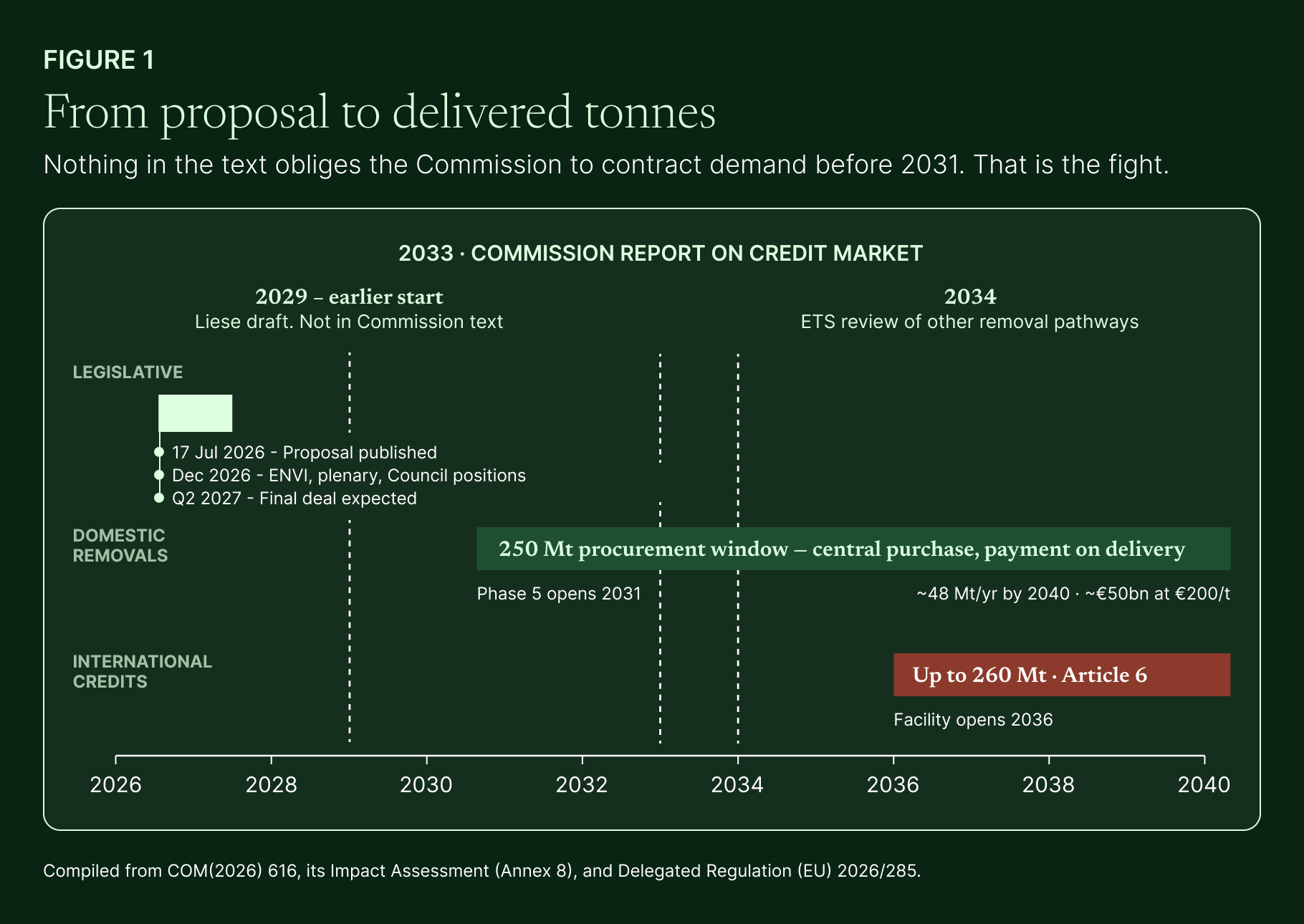
The headline architecture is straightforward. An extra 250 million allowances would be added to the Union-wide quantity and auctioned by the Commission between 2031 and 2040, with a further 10 million allowances from within the existing cap held in reserve in case revenue falls short. The proceeds fund the purchase of CRCF-certified permanent removals, with the Commission itself as the single buyer, payment on delivery and purchases ramping up to roughly 48 Mt per year by 2040.
Separately, from 2036, a second facility would deploy the revenue from another 260 million allowances to purchase up to 260 Mt of high-integrity international credits under Article 6. It is the ETS share of the flexibility in the amended European Climate Law, which sets a 90% net cut in emissions by 2040 and lets international credits cover up to 5% of 1990 emissions from 2036. The Commission must report on the credit market by January 2033, and the facility's detailed design is left to separate legislation.
At around €200 per tonne, that is a demand signal worth roughly €50 billion for domestic removals alone. The file is now in the ordinary legislative procedure. Rapporteur Peter Liese (EPP) published his draft report in September, and political groups tabled their amendments through October. Parliament's Environment Committee (ENVI) is scheduled to vote around December 1, with a plenary vote targeted for mid-December, while the Irish Council Presidency aims to secure the Council's position before the end of the year. Although EU leaders have targeted a deal by the end of March 2027, persistent divisions across political groups make an agreement in the second quarter far more realistic.
For carbon removal developers, the more important question is not simply how large the market could become. It is what the proposal tells us about the conditions for accessing it, and what needs to be built years before the first procurement begins.
Here is what we think matters.
1. The proposal is a demand signal with a hole in it
The Commission's own modeling assumes the sale of 250–260 million allowances will fund 250 Mt of removals. That arithmetic only works if the rising ETS price meets the falling cost of CDR at the right moment, and it rests on cost assumptions (BioCCS at €214/t in 2030 falling to €176/t by 2040, DACCS at €428/t falling to €278/t) that almost nobody in the industry recognizes.
Isometric has reproduced the modeling with more realistic inputs and concludes that the revenue from 260 million allowances will not cover the 250 Mt, leaving a gap of roughly €20 billion over the decade, or €2 billion a year. The Negative Emissions Platform (NEP) reaches the same conclusion from a different direction: the 10 million allowances earmarked to bridge the price gap represent about 4% of the removals envelope, and NEP wants them treated as a floor, not a ceiling, with more allowances assessed by the 2034 review at the latest. In Parliament, Liese would release as many allowances as needed, Renew's Emma Wiesner proposes 60 million plus a review, and the S&D and Greens oppose using allowances to close the gap at all.
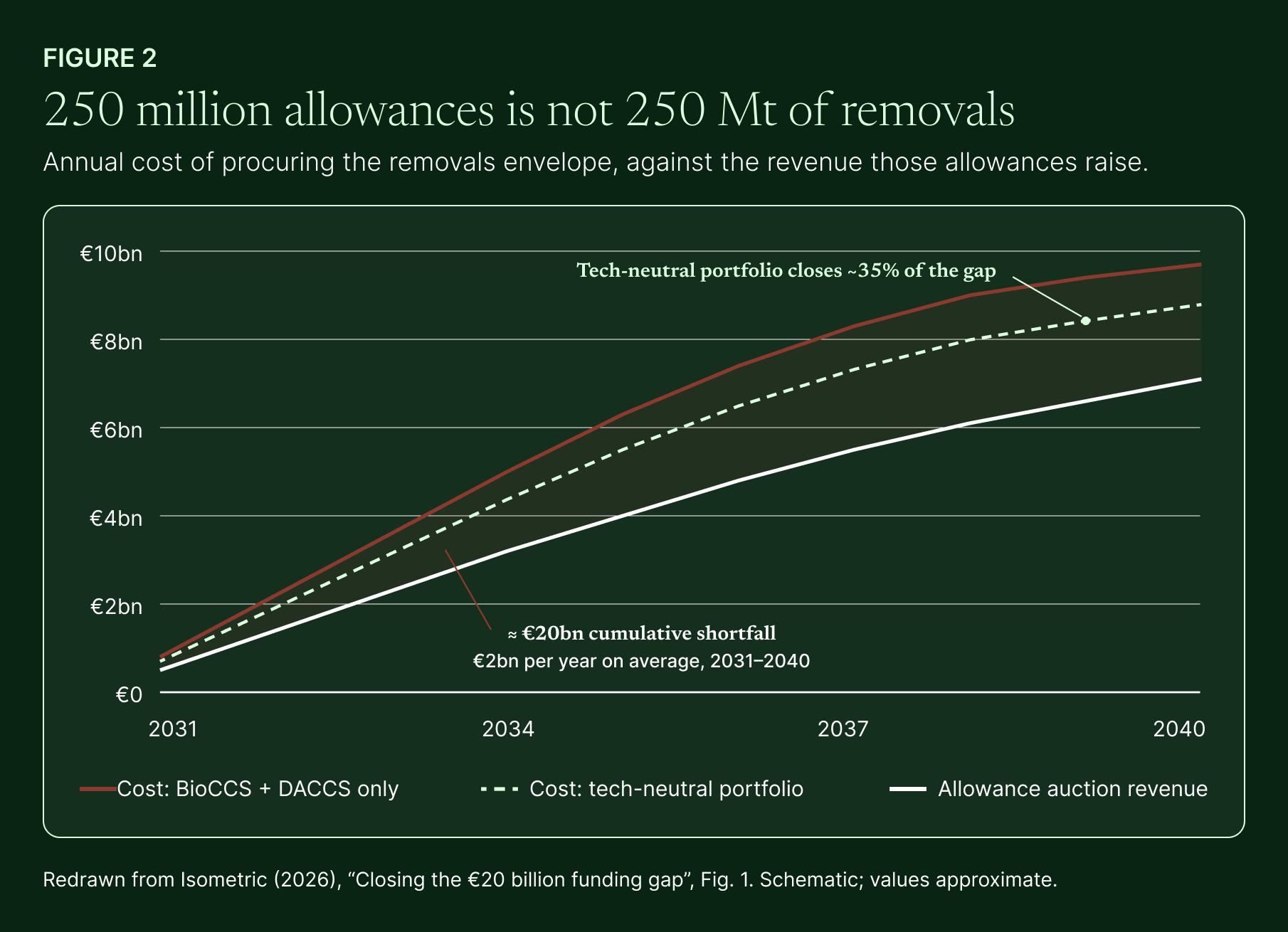
This is not a technical quibble. It is a design flaw with an environmental consequence. Because the allowances are added to the system and matched one-for-one against removals purchased, under-procurement means allowances enter the market without the corresponding tonnes ever being removed. A shortfall doesn't just slow the sector down; it puts net emissions into the ETS.
So the first thing to watch is whether Parliament converts a quantity of allowances into a quantity of tonnes. That single drafting change is the difference between a funding mechanism and a commitment. Parliament is split on the number itself: Renew wants to raise it to 300 Mt, while the S&D and Greens would cut it to between 75 and 100 million and keep it inside the existing cap. The industry position is clear: in September, NEP and four other carbon removal associations, together representing more than 170 companies, called for a binding obligation to deliver the full 250 Mt.
But there is a second implication of the funding gap. If Europe wants to reach 250 Mt of removals with a mechanism that may already fall short of the required funding, the composition of the eligible portfolio matters. A narrower set of technologies makes the target harder and more expensive to reach. A broader portfolio of credible pathways can help close part of that gap before additional money is found.
Which brings us to the more consequential question: what determines which removal technologies are actually allowed to participate in the market?
2. Compliance markets don't reward the cheapest tonne. They reward the most legible one.
The eligibility decision is where the real lesson sits.
Only BioCCS and DACCS are in scope initially. Biochar is out, despite having an adopted CRCF permanent-removal methodology since February, despite being the largest source of delivered durable removals on the voluntary market today, and despite an Impact Assessment that concludes biochar will generate permanent removal units under the CRCF and can meet many of the eligibility criteria. Parliament is pulling in both directions: rapporteur Peter Liese's draft report would add biochar through a delegated act by 2029, capped at 20% of the volume and subject to long-term monitoring and liability requirements, while the S&D and Greens would limit eligibility to DACCS alone.
Why, then? Reading the proposal, the operative rationale is that the Commission prefers removals where reversals are subject to monitoring and liability under an existing legal instrument, the CCS Directive. BioCCS and DACCS store carbon in geological formations already recognized under Directive 2009/31/EC. Admitting them extends a framework that exists. Admitting anything else means building one. Even the biochar amendment follows that logic: it makes inclusion conditional on a delegated act that sets enforceable long-term monitoring and liability requirements.
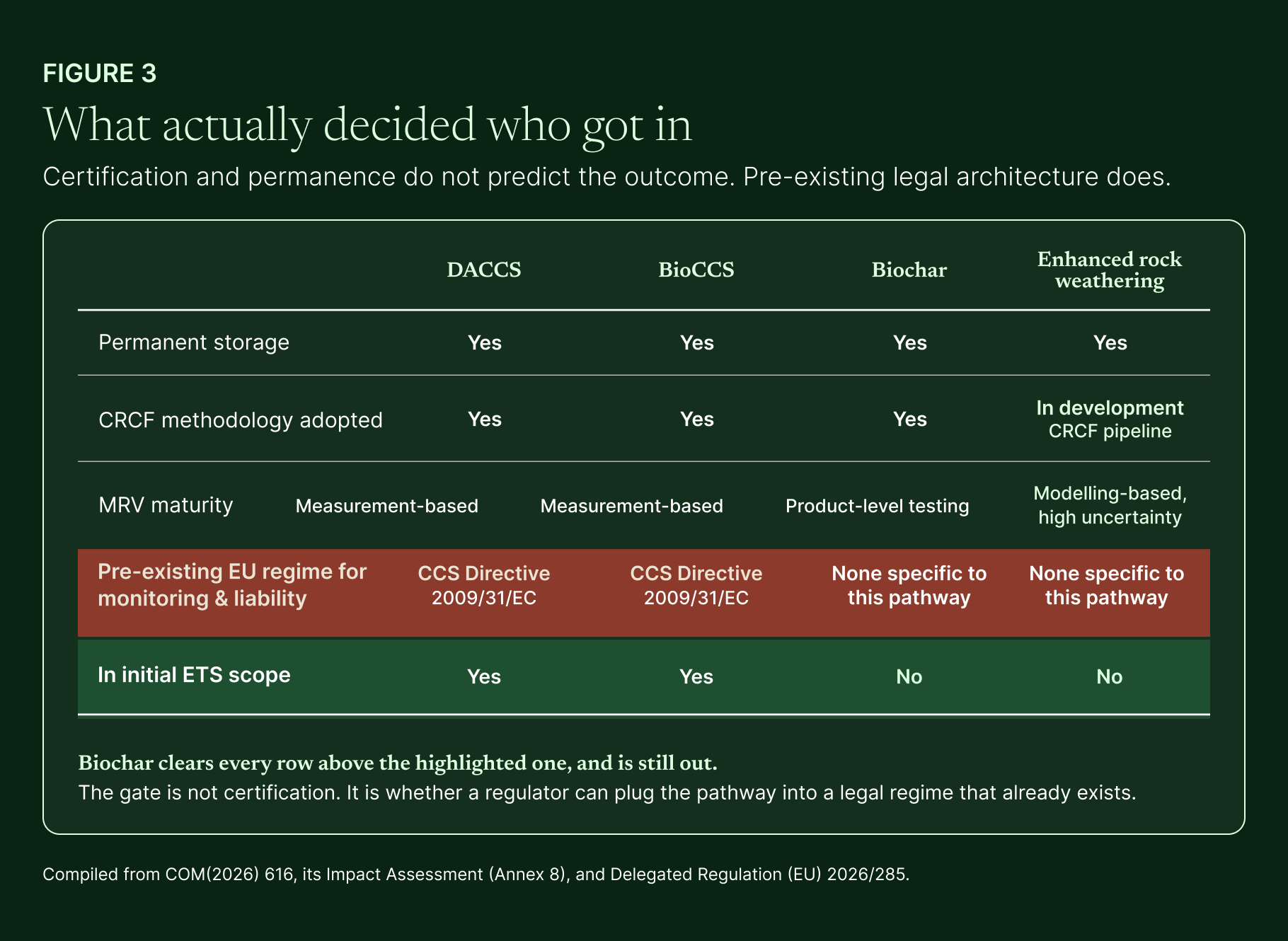
This is the insight we'd urge everyone in this sector to internalize: certification was necessary and it was not sufficient. The gate to compliance is not scientific merit, or cost, or even a CRCF methodology. It is regulatory legibility: whether a regulator can plug your pathway into a monitoring, liability and accounting architecture that already exists and already carries legal consequences.
And the honest, useful part of that argument is that the architecture is not actually missing. Article 12(3b) of the ETS Directive already establishes that carbon "permanently chemically bound in a product" sits outside CCS Directive monitoring and is instead covered by the permanent CCU Delegated Act, which defines in law which processes deliver storage lasting centuries, mineral carbonates among them. The precedent for regulating non-geological permanent storage is on the statute book. The question is whether co-legislators use it.
That reframes the tech-neutrality argument entirely. It is not a fairness claim. It is a cost claim: a narrower portfolio makes the 250 Mt harder and more expensive to reach, and a wider one closes about 35% of the funding gap before a single euro of new money is found. Brussels responds to arithmetic.
3. Where this leaves enhanced rock weathering, stated plainly
ERW is not in scope, and we're not going to pretend otherwise. The Commission's own comparative assessment of removal pathways is unsparing: permanent storage, yes; environmental co-benefits, yes; but no CRCF methodology, modeling-based quantification, high uncertainty, low ease of MRV. Overall recommendation: needs further research.
We don't think that assessment is wrong. We think it's a specification.
It tells us precisely what closes the gap, and none of it is lobbying. It is field data, reduced model uncertainty, and MRV that a regulator can audit rather than take on faith. The Commission held its technical workshop on ERW and ocean alkalinity enhancement in September 2025, and its contractors' review of ERW was published in March. ERW is on the agenda of the upcoming Carbon Removal Expert Group meeting on November 10, listed as “on-going development of methodology”. The methodology will come, but not quickly: going by the first CRCF methodologies, an ERW delegated act is unlikely before late 2027. What determines whether it converts into market access is whether, by the time it lands, ERW has already answered the monitoring-and-liability question, because under the Commission's text biochar is the proof that arriving with a methodology and nothing else means waiting a decade for a review clause.
That changes the strategic question for ERW developers. The goal should not simply be to obtain a methodology when the regulatory window opens. The goal is to arrive at that window with the evidence and infrastructure already in place: field data, robust quantification, auditable MRV, monitoring systems and a credible approach to permanence, monitoring and liability.
In other words, the compliance market is being built now, even if the first procurement does not arrive until 2031.
For anyone building in this space, the strategic instruction is unambiguous: build for auditability now, not for the voluntary market's tolerance for uncertainty.
4. The Brazil interlock: Europe is building demand, Brazil could supply it
We work on this from Brazil, and the interesting thing about watching Brussels from São Paulo is how visibly Brazil is watching back. The Brazilian Emission Trading System (SBCE), established by Lei 15.042/2024, is being written with the EU ETS as an explicit reference model: cap-and-trade, phased MRV and a regulated registry. The Ministry of Finance's Extraordinary Secretariat for the Carbon Market (SEMC) opened its MRV consultation on July 28 (open until August 28), with monitoring beginning for some sectors in 2027 and full operation expected around 2030–2031.
Note that date. Brazil's regulated market reaches full operation almost exactly as EU ETS Phase 5 begins.
The strategic significance for Brazil is therefore bigger than regulatory alignment. Europe is beginning to build the demand side of a future compliance market for removals at the same time that Brazil is building the infrastructure for its own regulated carbon market.
The second track matters more for removals. The consultation by the Ministry of the Environment and Climate Change on internationally transferred mitigation outcomes (ITMOs) closed on August 6. The proposal sketches Brazil's Article 6 machinery: a positive list of eligible activities, Future Transfer Agreements concluded by the Designated National Authority (DNA), public calls to select projects eligible for authorization, and a limit of 50% of the mitigation outcomes generated by any project or program between 2031 and 2035. The draft also caps transfers at 50 Mt over that period and leaves the Interministerial Committee on Climate Change (CIM) to set volumes every two years. Since then, SEMC head Cristina Reis has said authorizations and contracts could start as early as 2027, and an earlier 2025 to 2030 window is also under discussion.
Now put the two calendars side by side.
Brazil has proposed its authorization limits for 2031–2035. The EU's international credit facility opens in 2036. The single largest sovereign buyer of Article 6 units on the horizon begins purchasing in the exact year Brazil's stated authorization ceiling stops being defined. And the EU side is not settled either: the S&D, Renew and the Greens have all tabled amendments to keep international credits out of the ETS.
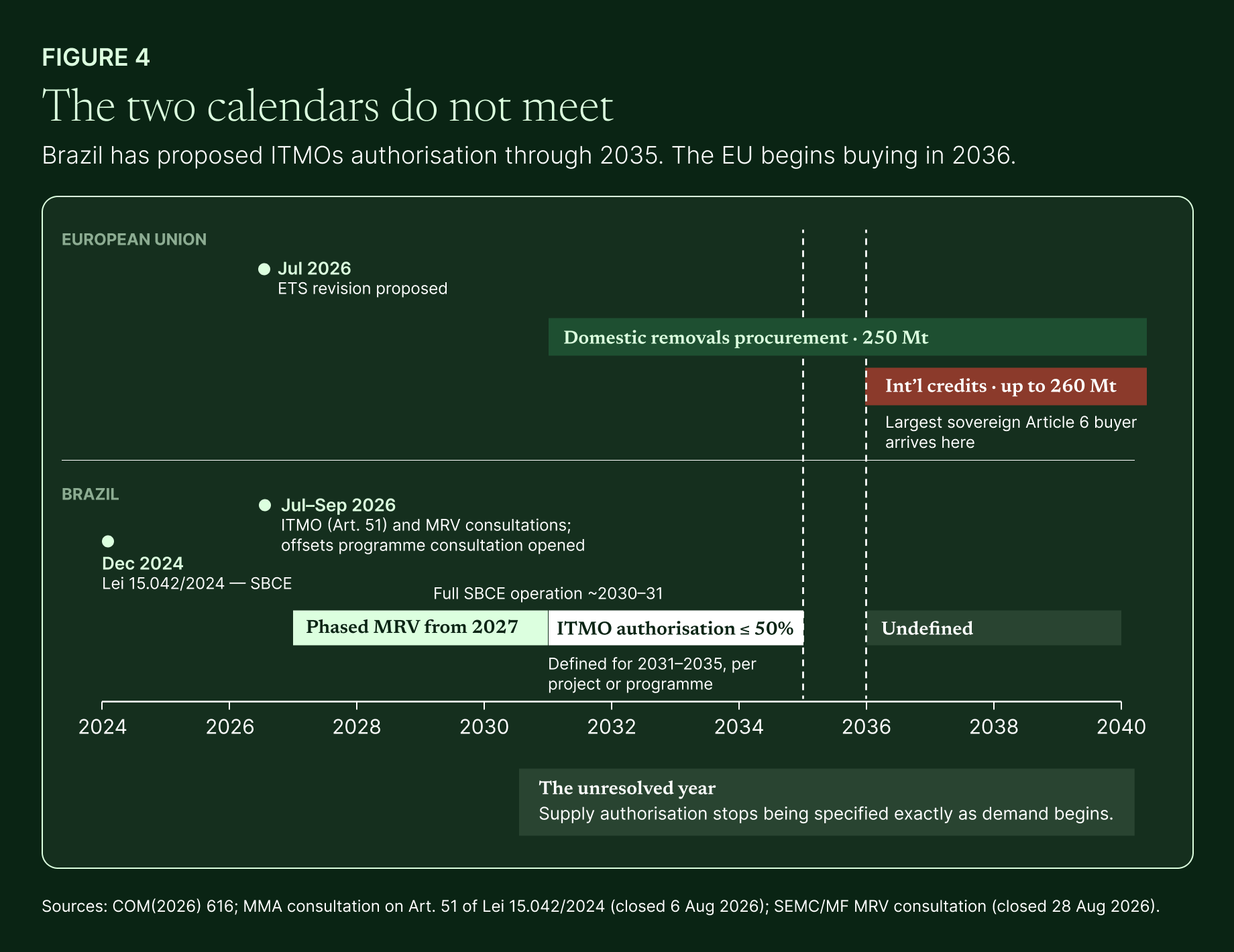
That is not a criticism of the Brazilian proposal; it's a natural consequence of drafting against Brazil's own NDC period. But it is a genuine unresolved question, and it is the one we'd put to both sides. The binding constraint on Article 6 supply globally has never been project volume; it has been authorization and corresponding adjustments. CORSIA shows what that looks like: IATA counted about 72 million eligible units covered by host-country letters of authorization in August, against first-phase demand of 200 to 250 million, a gap of about 150 million units to close by January 2028. If Europe arrives in 2036 with a €50 billion-scale purchasing facility and finds the same bottleneck, the constraint will not have been technology. It will have been paperwork sovereign governments could have prepared a decade earlier.
Brazil is unusually well placed here: it has the framework law, the DNA, the removals resource base, and an agricultural land bank that makes it one of the few places ERW can scale to compliance-relevant volumes. What it needs is authorization infrastructure that extends past 2035 and interoperates with whatever integrity criteria the EU facility eventually publishes, criteria which, notably, remain undefined pending a separate Commission proposal, with a market review due by January 2033.
What we're watching
- Parliament and Council positions, and specifically whether '250 million allowances' becomes '250 Mt of removals' in the operative text. The immediate milestones to watch are the scheduled ENVI committee vote around December 1, the plenary mandate later that month, and whether the Irish Presidency can broker a Council general approach before year-end.
- Whether biochar survives the ENVI vote and trilogue. It's the tech-neutrality bellwether. If a pathway with an adopted CRCF methodology and a favorable Impact Assessment can't get in, the 2034 review becomes the only door for everyone else. The draft report brings biochar in at up to 20% of the volume; the S&D and Greens would leave it out.
- How monitoring and liability get resolved, via the existing CRCF Delegated Act, an amended permanent CCU Delegated Act, or a new instrument covering non-geological permanent storage. This determines the on-ramp for ERW and mineralization.
- Whether offtakes are brought forward to 2029. A Commission official has said offtake agreements will probably need to be signed before purchasing begins in 2031, but nothing in the text requires it. Payment on delivery in 2031 without contracted demand beforehand means first units around 2035. Bankable demand is the whole ballgame. The draft report would bring the start forward to 2029; whether that survives is one of the main open questions.
- The CRCF methodology pipeline for enhanced rock weathering and carbonation/mineralization, starting with the Carbon Removal Expert Group's dedicated discussion on ERW on November 10.
- Brazil's SBCE offsets consultation, which the Ministry of Finance's 2026 calendar puts in October, with final rules by December, the planned pilot of credit origination in the first half of 2027, and what happens to ITMO authorization limits beyond 2035, measured against the integrity criteria the Commission has yet to propose for international credits.
The direction of travel is no longer ambiguous. Carbon removal is moving from voluntary purchase to compliance obligation, and the EU has put a multi-billion-euro, decade-long price tag on the table to prove it. What the proposal also makes clear is that access to that market is earned in advance, in the unglamorous work of measurement, auditability and legal architecture, years before the demand arrives.
The sector spent a decade arguing that removals are real. The next decade is about proving they are countable.
Maria Freitas is Head of Marketing & Public Affairs at InPlanet, an enhanced rock weathering company operating in Brazil, and contributes to policy work through the Negative Emissions Platform and the Enhanced Weathering Alliance. Views are my own.
Eduardda Pivatto is Commercial & Policy Lead at InPlanet, based in Brazil. Views are my own.
Latest Posts

All Soil Was Once Rock
Why basalt can transform tropical soils? A founder's perspective about what we do at InPlanet

The rich mosaic of soil heterogeneity, and how to navigate its complexities
Understand how to navigate the complexity of soil to achieve accurate measurements in carbon dioxide removal projects.

InPlanet and Idemitsu Americas Holdings Close Non-Recourse Debt Facility, Setting a New Standard for Financing ERW Carbon Removal
The transaction secures capital against contracted, insured delivery of durable removals, proof that high-integrity projects can now access scalable debt beyond equity.

InPlanet selected as the Brazilian supplier in Whirlpool Corporation's durable carbon removal portfolio
Structured by ClimeFi, the agreement pairs a firm 2030 delivery with standalone options, expanding Enhanced Rock Weathering across Brazil's agricultural heartland.